Why TropX Puts Two Sensors on Every Leg
A joint angle is the relative orientation of two body segments. We measure both segments directly, so the angle is measured rather than estimated.
You cannot sense a knee angle at a single point on the body. The angle is the relative orientation between the femur above the joint and the tibia below it. A system that instruments only one of those segments has to estimate the other, and the estimate is least reliable during fast or unusual movement, which is exactly when a clinician most wants a trustworthy number.
TropX instruments both segments. Each leg wears two inertial measurement units, one on the thigh and one on the shank. The knee angle is computed from the relative orientation of the two sensors. Nothing about limb length or typical movement patterns is assumed.
From raw motion to a live skeleton
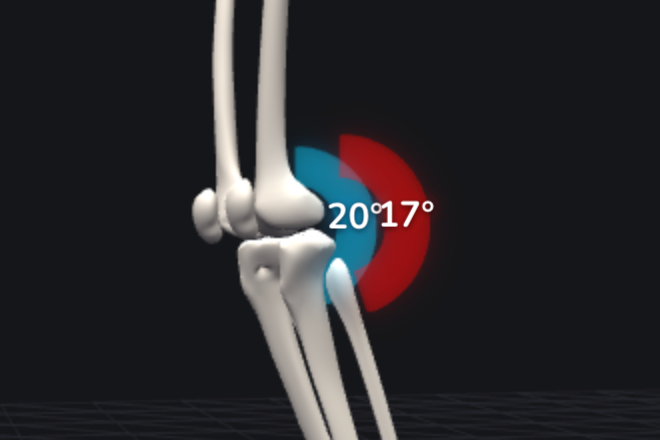
The fused sensor streams drive a live 3D reconstruction of the lower body, built on a skeletal model. While the patient moves, the app renders the legs in real time and can be viewed from the front, the side, or behind. The flexion readout sits on the knee itself, left leg in blue, right leg in red.
Angles follow the clinical convention. A fully straight leg reads 0 degrees, and the number grows as the knee bends. A physiotherapist writes that convention in a chart, so the app reports it the same way.
What the pipeline computes
None of this needs a camera or a lab. The sensors measure whatever they are strapped to, in the clinic or at home. Sessions are recorded, and any rep can be replayed later against the skeleton and the synchronized left/right waveform.
- Knee flexion and extension for each leg, continuously, with left and right shown side by side
- Automatic rep segmentation, so every metric can be reported per repetition
- Per-rep kinematics such as range of motion, peak angular velocity, and movement smoothness (SPARC)
- Left/right symmetry, including velocity asymmetry and cross-correlation across the movement
- Consistency of range of motion across the reps of a session
Measuring both segments is a simple decision with long consequences. Every number downstream of the angle, from the single-rep readout to a season of progress charts, inherits the accuracy of that first measurement.